

There has been much hand-wringing about the state of college football these days.
Traditionalists bemoan how the Transfer Portal has ruined the game and they long for the days when coaches ruled with an iron fist while the serfs -- excuse me, "student-athletes" -- did what they were told.
Well, the portal is here to stay and players will continue to get paid real money for their labors. However, that doesn't mean the game couldn't use some common-sense changes. The industry desperately needs more stability now.
With that in mind, here are some modest proposals that should be implemented before the start of next season.
1.
Push the Transfer Portal Date To Two Weeks In February. The portal opens on January 2 and runs to the 16th. The final two teams in the College Football Playoff get five extra days to enter the portal. The spring portal period was eliminated.
This is better than it was before, but it's not good enough.
Moving the opening of the portal to February 1 would allow all programs time to exhale after the season and better evaluate the players they plan to pursue. Early February would conflict with National Signing Day, but that can be moved to a later date with little or no problem.
It certainly would help USF football this season, giving incoming head coach Brian Hartline a little time to get acclimated to his new job after Ohio State's season ends.
Besides, opening the portal while the playoffs are ongoing also takes the spotlight off the games and puts it on players who are changing addresses.
That brings us to the next rules change.
2.
Shut the portal's revolving door. College football is filled with players who have transferred three or more times, and there's no rule against that. In many cases they're chasing NIL paydays or they're mad because they aren't the star at their current team they figured they would be.
Either way, that's bad for the game.
So, here's the solution. A player can transfer two times with no penalty. However, if he wants to move a third or fourth time, it comes with a mandatory one-year waiting period. The exception would be if the player's current coach left or was fired, he can have an exemption.
The benefit to the teams is obvious because it gives them a little stabilty. The benefit to the player is that it adds a layer of needed seriousness to the portal, theoretically leading to better decisions.
3.
Institute a limit on the amount of buyout money a school pays a fired coach. This one would be tricky and coaches would fight it fiercely because it could make it easier for programs to rid themselves of struggling or unpopular coaches.
Tough beans,.
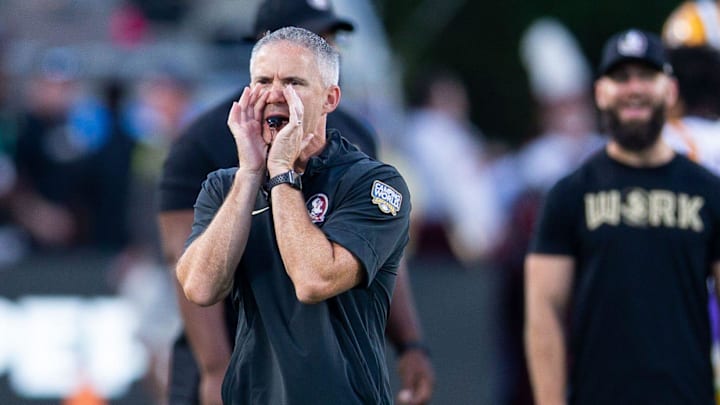
Florida State is stuck with Mike Norvell because it would have had to pay a wildly unpopular coach more than $58 million to go away if the Seminoles fired him after two straight losing seasons. Well, that's the fault of whoever negotiated Norvell's contract, and it's just the most egregious example of why the current system is bad. Athletic directors can't seem to fall all over themselves when they zero in on a coach they want.
Let's add another caveat here.
It's not unusual for coaches to leave well before their contract is up. So, let's say a coach signs a five-year extention at his school. Make it mandatory that he stays for at least three years.
4.
Bring back the "five years to play four seasons" rule. It was fair when the NCAA gave players affected by the COVID-19 lockdowns an extra year of eligibility, but it should have stopped there.
It's not unusual anymore to see a player in his sixth or seventh season.
Quarterback TJ Finley has already played for five schools in six seasons, the latest being Georgia State. He got the extra COVID year, but now has announced he is in the portal again and has applied for a seventh year of eligibility.
Just stop it!
The old system worked better.
Bring it back.
5.
Oh, and here are two playing rules changes that should be made. A defensive back knows he is beaten on a long pass that will likely end in a touchdown. To stop that, he purposely commits pass interference.
Sure, he gets a flag but in college that's only a 15-yard penalty. The ball should be placed at the spot of the foul, like happens in the NFL. Let's say the play starts at the 50-yard line. The passing team is, in effect, penalized considerable yardage it should have had because of a rule put in place in 1984.
Technically, an official can call it a spot foul if he believes the foul was deliberate, but c'mon. Have you ever seen that called?
The other rule change is that a runner is declared down if his knee touched the ground, even if there was no contact That archaic rule was probably put in place when players wore leather helmets, and it needs to change. These are big boys playing a big boy game.
Let 'em play.
 Add us as a preferred source on Google